Full-set NAVSIM PDMS
87.976 → 88.589 across 10 held-out controllers
ExecutionBridge
Adapting Frozen World-Model Planners to Controller-Induced Execution Shift
A frozen world model can imagine the wrong future when a new controller executes the same plan differently. ExecutionBridge keeps the plan intact and adapts the imagined future before candidates are scored.
Research prototype · evaluated on NAVSIM
87.976 → 88.589 across 10 held-out controllers
32.038 → 46.128 on difficult scenes
better execution, almost no decision gain
01 / Why it matters
World-model planners evaluate each candidate by imagining what happens after it is executed. A deployment controller with different gains, lag, or actuation can turn that same plan into different motion, leaving the frozen model to evaluate a mismatched future.
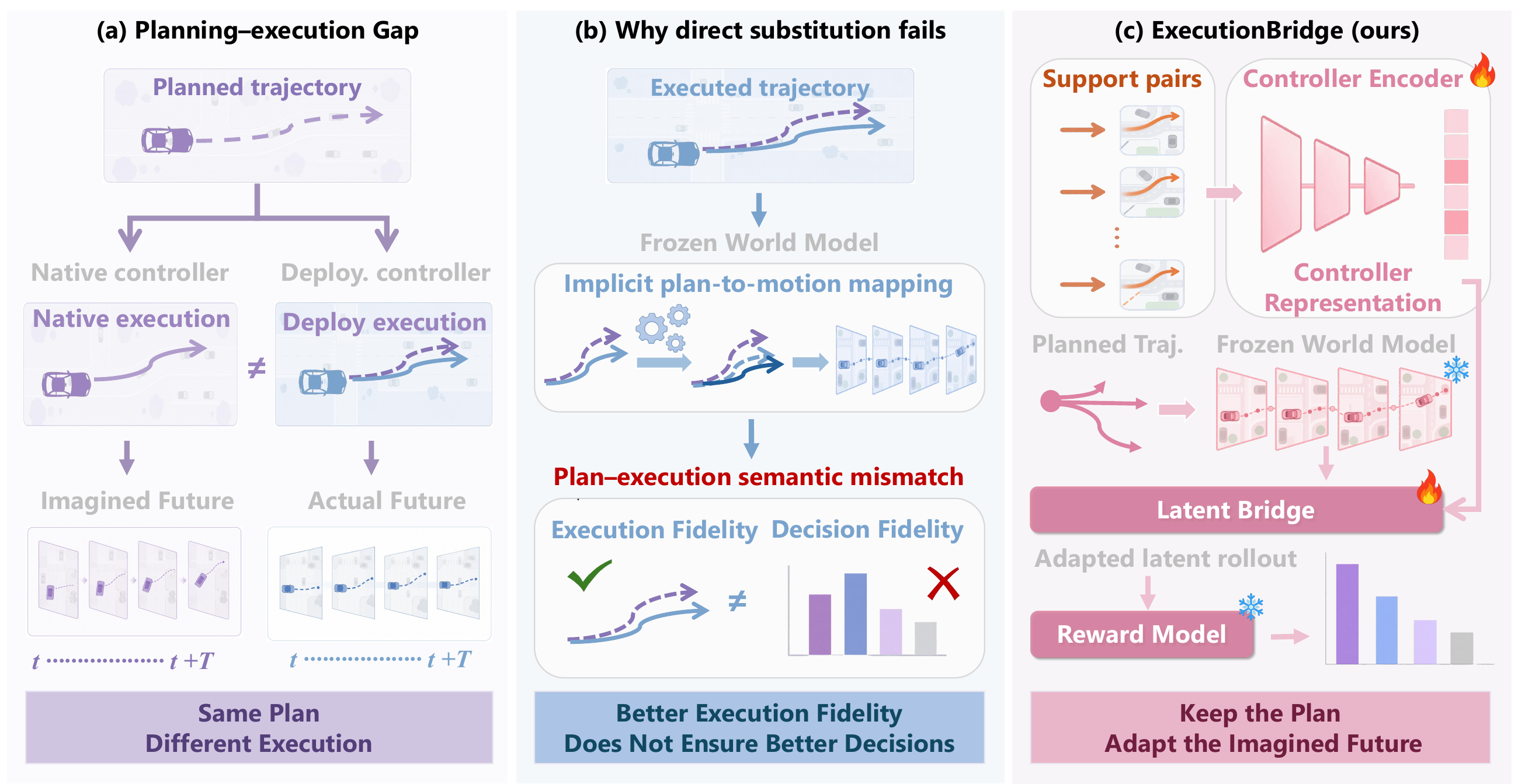
02 / Controller shift
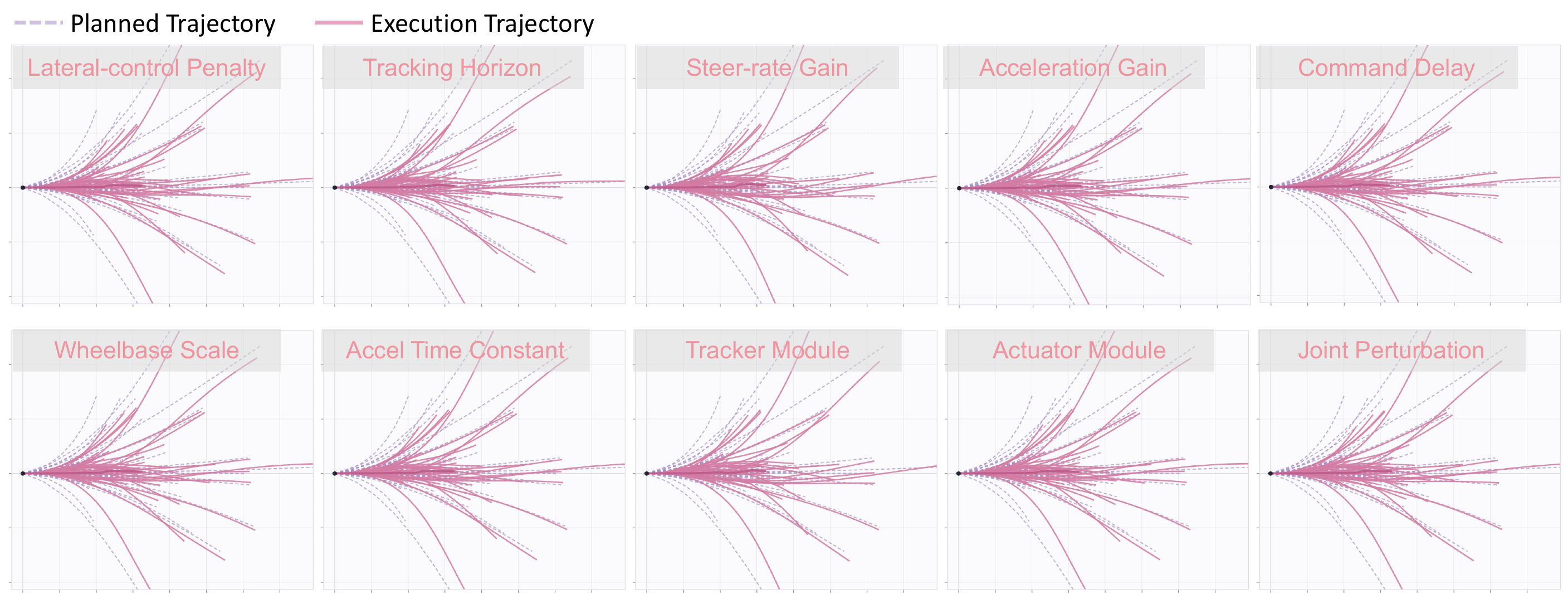
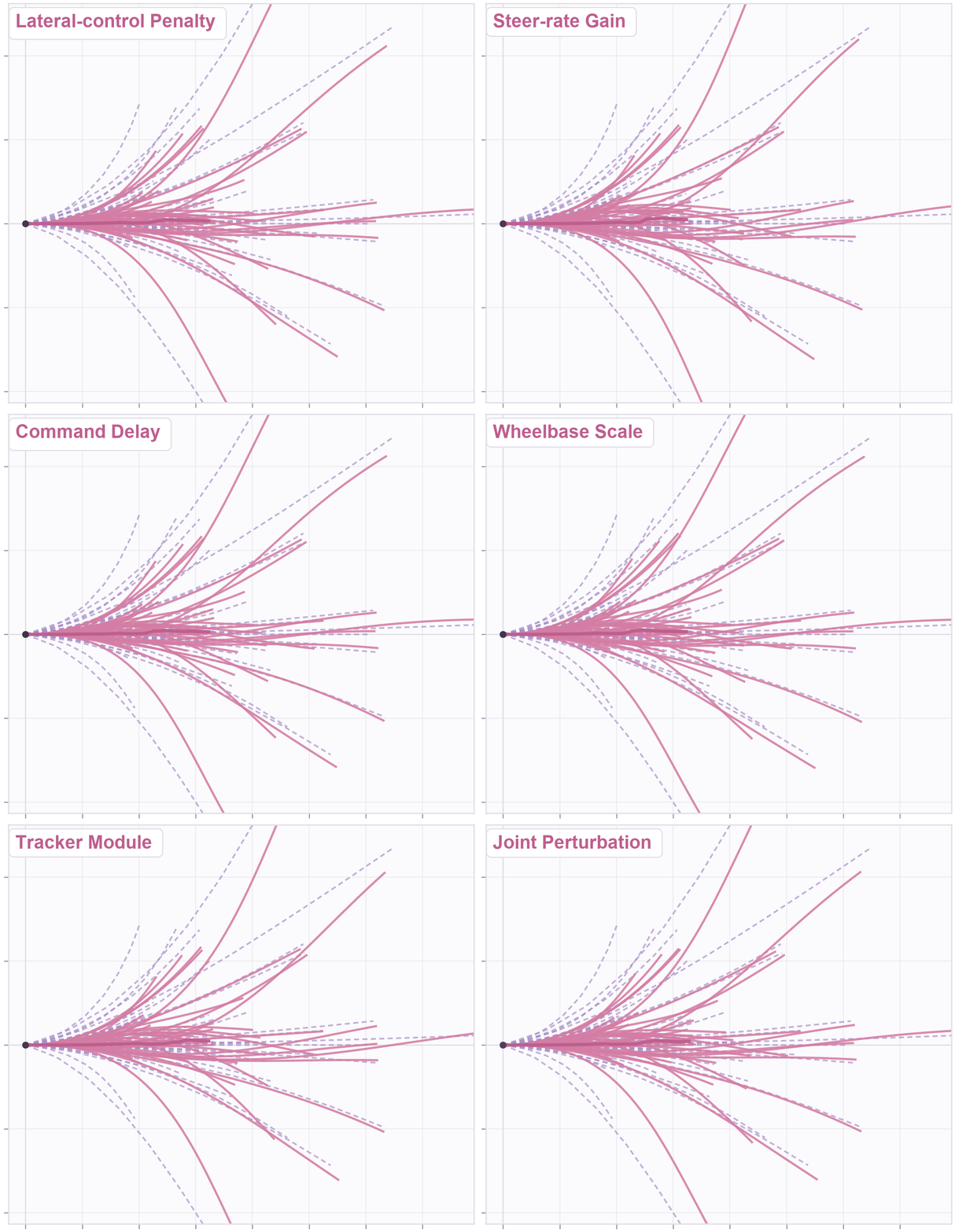
The evaluation holds out ten controller configurations. The static atlas shows the parameter changes; the animation makes the shift visible by comparing each planned trajectory with its executed trajectory.
03 / Method
ExecutionBridge learns controller-specific execution characteristics from support pairs. It leaves the planner, world model, reward head, and candidate trajectories untouched, then adapts only the ego-related latent before scoring.
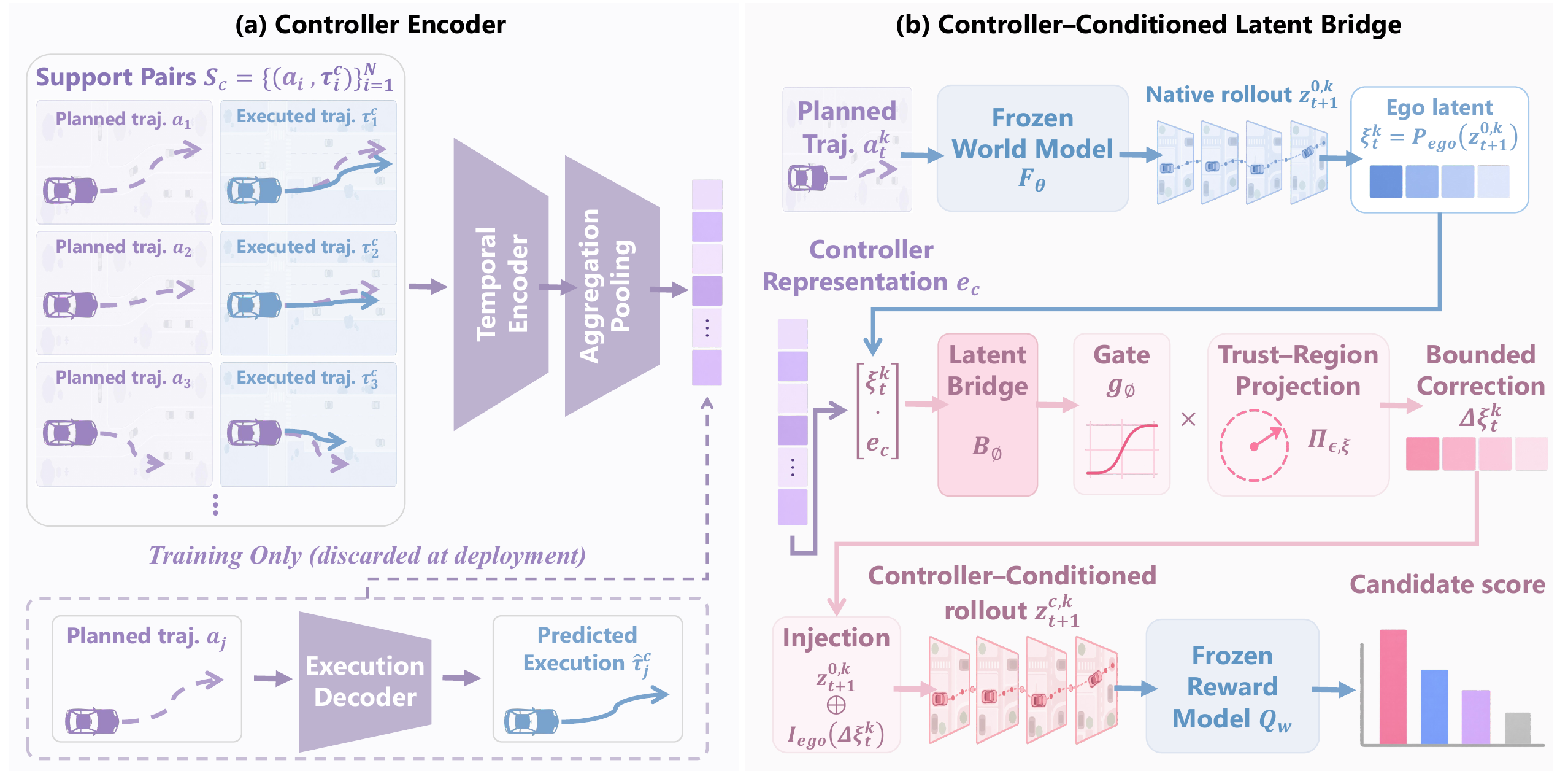
Collect planned-executed trajectory pairs from the deployment controller.
Summarize those pairs into one compact controller representation.
Apply a gated, trust-region correction to the ego latent rollout.
Use the unchanged reward model to rank the original candidates.
Support-set identification
A temporal encoder pools planned-executed pairs into a compact representation of persistent controller behavior. At deployment, this representation is computed once and cached.
Trust-region adaptation
A gated, bounded correction adapts the native ego rollout while preserving the planned trajectory and frozen reward model. No online optimization is required.
04 / Results
ExecutionBridge improves planning across ten held-out controller configurations under a controller-disjoint protocol. The direct-substitution diagnostic raises full-set PDMS only from 87.976 to 88.024 (+0.048), while ExecutionBridge keeps the original plan and adapts the imagined future for +0.613 overall and +14.090 on the fixed low-score subset.
Controller-induced shift
+14.090low-score PDMSAll evaluation scenes
87.976 → 88.589full-set PDMS Improved on all 10 unseen stylesDiagnostic · direct substitution
+0.048full-set PDMS · 88.024 vs 87.976Execution geometry improves; candidate ranking barely moves.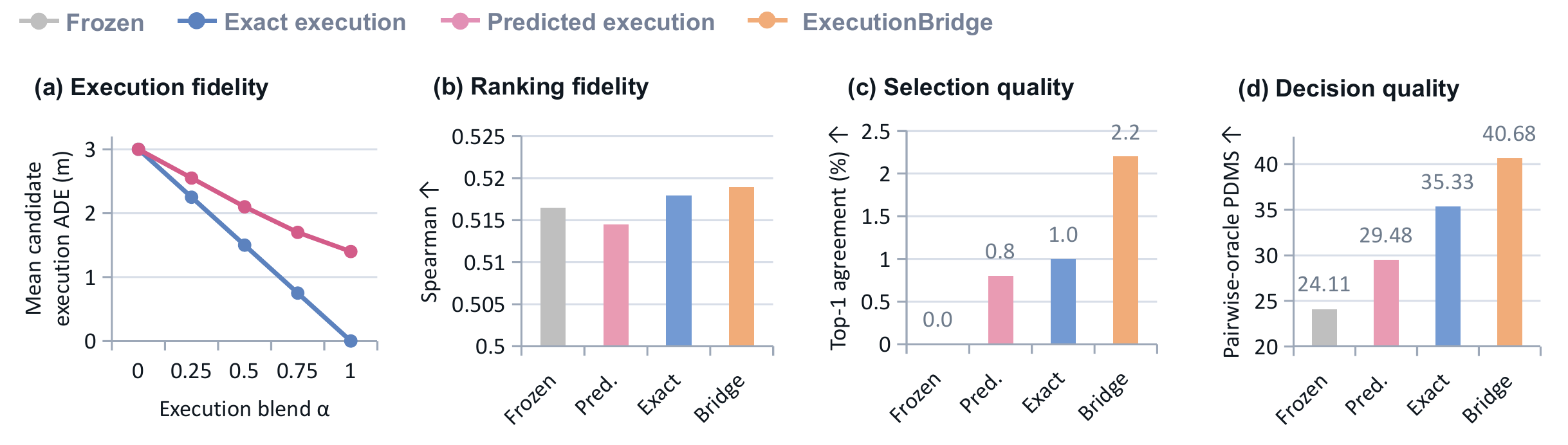
Ablation · Table III
| Variant | Full | Low-score |
|---|---|---|
| Frozen WoTE | 87.976 | 32.038 |
| Decision-only | 88.071 | 35.214 |
| Score calibration | 88.184 | 40.327 |
| Residual-conditioned | 88.312 | 45.550 |
| ExecutionBridge | 88.589 | 46.128 |
Takeaway. Conditioning the latent bridge on the controller representation outperforms score-only and candidate-residual variants.Support-set sensitivity: full PDMS stays near 88.44 and low-score PDMS near 45.95 from N = 64 to 1024.
Cross-backbone transfer
| Frozen planner | Native PDMS | With ExecutionBridge | Gain |
|---|---|---|---|
| WoTE | 88.2 | 88.8 | +0.6 |
| ResWorld | 88.3 | 88.7 | +0.4 |
| WorldDrive | 89.0 | 89.3 | +0.3 |
05 / Qualitative results
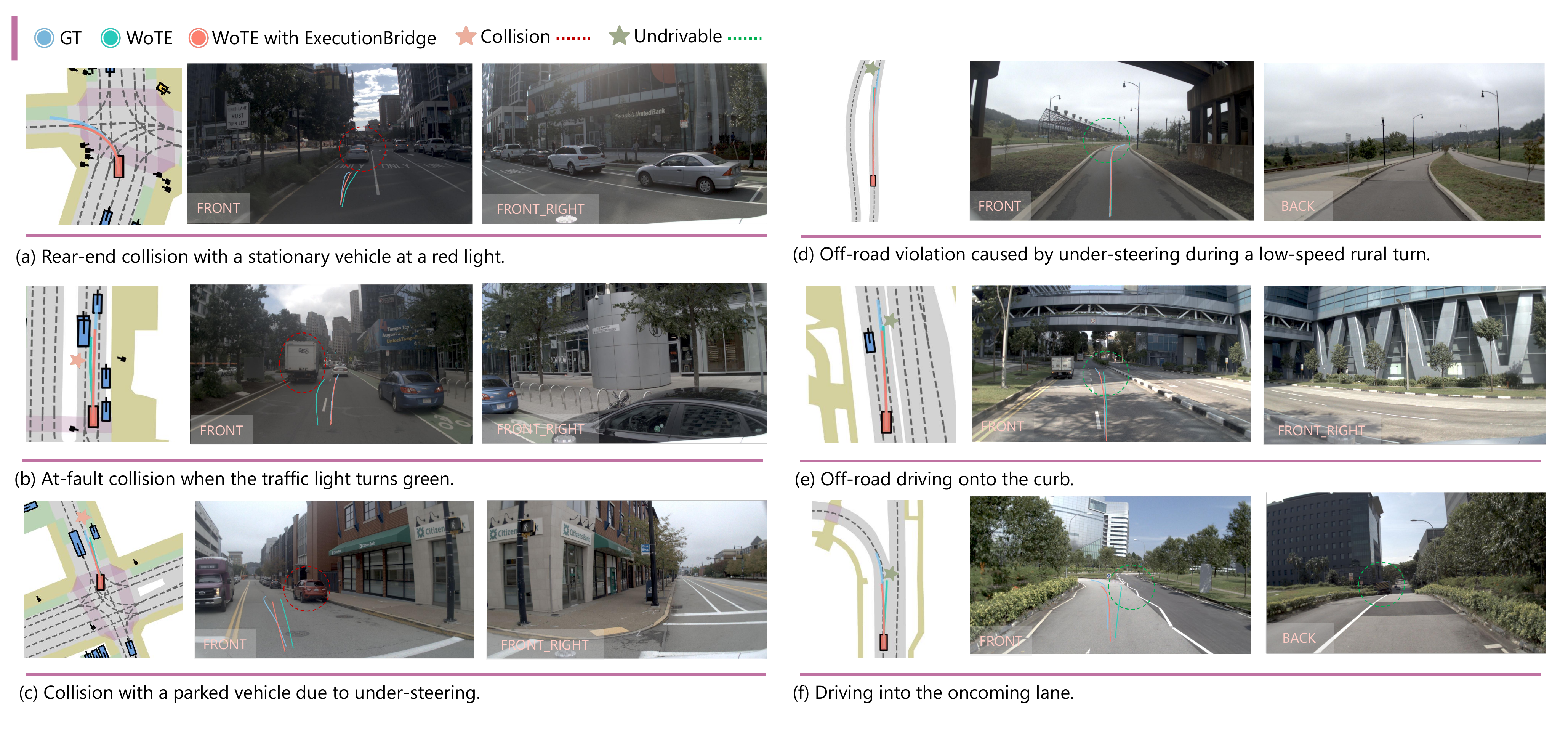
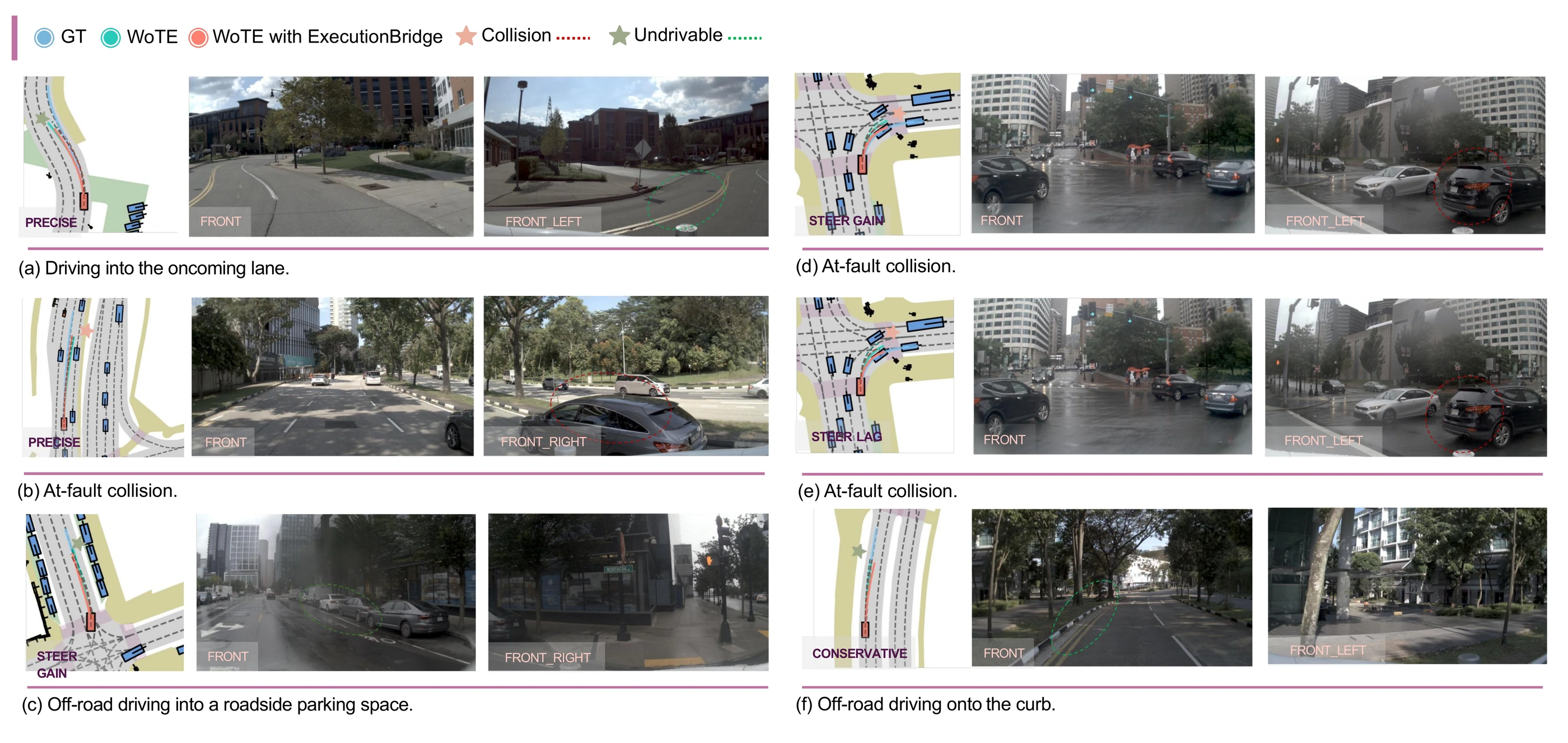
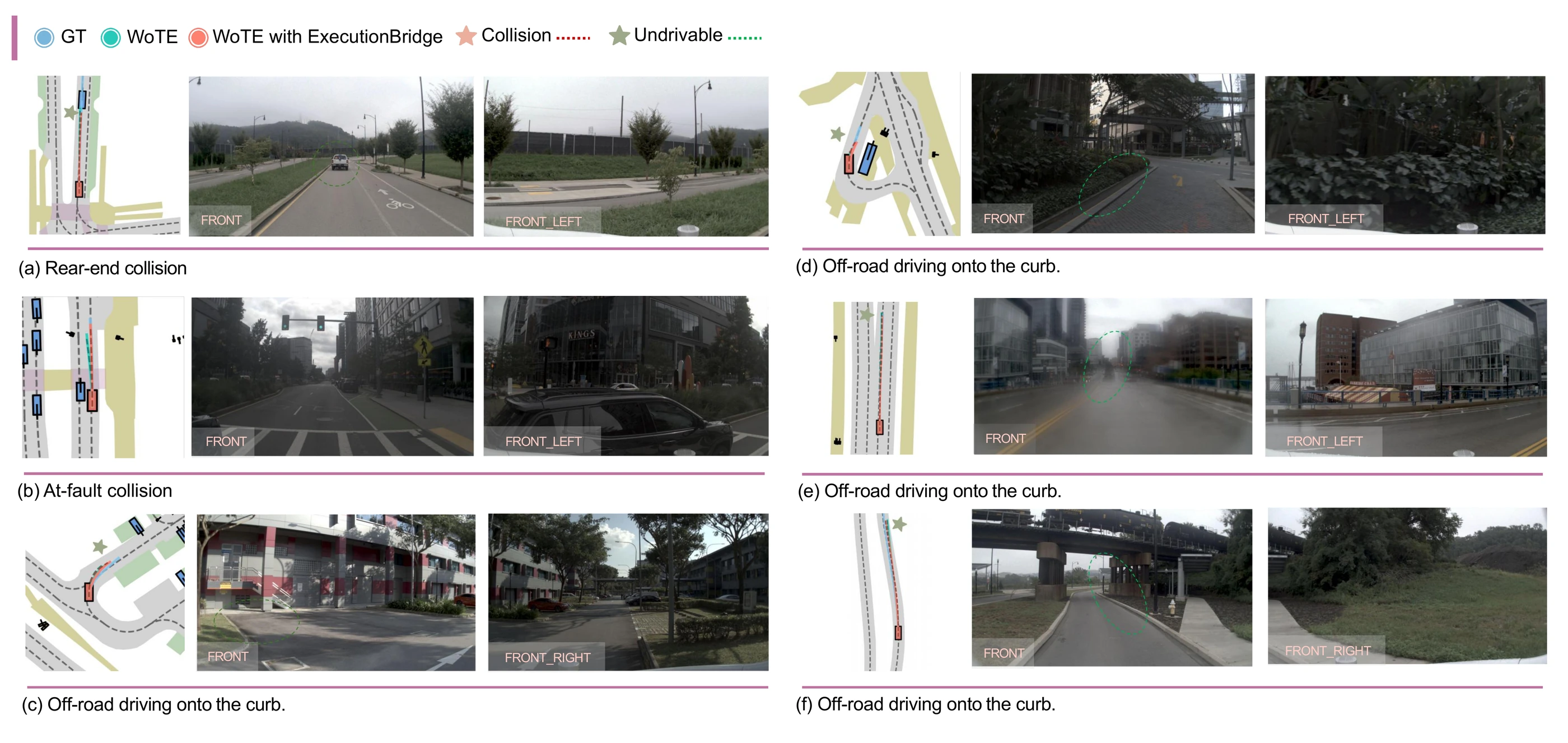
Across representative NAVSIM scenes, the bridge changes which candidate is selected in cases involving rear-end collisions, under-steering, curb violations, and oncoming-lane failures.
06 / Reproduce
The evaluation protocol, held-out controller setup, and resource layout will be released with the anonymized code package.
quick-start.sh
# Reproduction package will be released after review.
# The paper documents the held-out controller protocol.
# Machine-specific datasets and checkpoints stay outside Git.
Resources
Plans Are Not Executions: Adapting Frozen World-Model Planners to Controller-Induced Execution Shift. Citation metadata will be added with the public paper release.